Do Artificial Hedges Need Less Maintenance Than Living Hedges?
Yes — and the gap is structural, not marginal. A living hedge needs irrigation, feeding, pest control and two to six trims per growing season; an artificial hedge needs a dry dust pass roughly every quarter indoors, one or two hose rinses a year outdoors, and a fixing check after storms. UV-stabilised foliage holds its colour for 3–5 years in direct sun, and replacement panels ship in 7–15 days.
November 20, 2026 · Care & Maintenance · 8 min read · By Everflorae Editorial Team

- The two products run different maintenance clocks: a living hedge is gardening (water, feed, cut, treat), an artificial hedge is housekeeping (clean, check, replace panels).
- Living hedges commonly get two to six trims per growing season; artificial hedges are never trimmed — their form is fixed at manufacture.
- Artificial hedge foliage is rated for 3–5 years of direct-sun colour outdoors; faded sun-facing panels swap out in 7–15 days in standard formats, custom runs take 20–45 days.
- Living hedges still win on biodiversity, cooling and self-repair — if the site has water, light and a gardening budget, they remain the better long-term choice.
What maintenance means on each side of the comparison
The cleanest way to compare artificial hedge vs living hedge maintenance is to accept upfront that they are not the same kind of work. A living hedge is gardening: it is a crop grown to a shape, and everything on its schedule — irrigation, feeding, pest and disease control, trimming, replanting gaps — exists because the plant keeps growing and keeps responding to the weather. An artificial hedge is housekeeping: the geometry is fixed at manufacture, so nothing on its schedule exists to control growth. The work is cleaning the foliage and checking the structure it hangs on.
That difference decides everything downstream, including who does the work (a gardening contractor versus your own cleaning staff), what equipment is needed (irrigation lines and climbing access versus a ladder and a soft brush), and what failure looks like (dieback and bare patches versus fading colour and loose fixings).
The maintenance calendar, side by side
Here is the recurring work of each product over a typical year, for a commercial screening hedge of roughly 1.8–2 m height:
| Task | Living hedge | Artificial hedge |
|---|---|---|
| Watering | Regular in dry spells; heaviest in the first 1–2 growing seasons; often needs an irrigation line | Never |
| Trimming | 2–6 cuts per growing season for formal shapes; less for informal species | Never — the form is fixed at manufacture |
| Feeding | Seasonal fertilising programme | None |
| Pest & disease | Aphids, fungal leaf spot, species-specific pests; treatment every season | None |
| Cleaning | Not applicable (growth replaces soiling) | Dry dust pass every 4–6 weeks indoors; 1–2 hose rinses a year outdoors (3 in coastal salt air) |
| Structure checks | Not applicable | Fixings, joints and panel edges twice a year and after major storms |
| Seasonal appearance | Semi-evergreen species thin or go brown in winter | Unchanged through the year |
| Colour lifecycle | Re-greens each spring; gaps from dieback need replanting | 3–5 year UV colour rating outdoors; swap the sunniest panels when they fade |
Read as a whole, the living hedge’s calendar is a programme with a contractor attached; the artificial hedge’s calendar is a checklist your own team can run.
What the labour difference looks like over a year
Numbers make the comparison concrete. Take a 20 m² hedge run. On the artificial side, a dry dust pass costs a few minutes per square metre, so one pass is roughly a one-hour job; a full wet clean is a half-day including drying; and two fixing checks take minutes each. Across a year, that is a handful of hours — and none of it needs specialist equipment beyond a ladder, a soft brush and a hose.
On the living side, the same hedge needs a trimming visit each time it is cut (two to six visits a year for a formal hedge), a watering schedule that in most climates means an installed irrigation line — with the winterising and leak checks that implies — a seasonal feeding programme, and someone to watch for pests and fill in gaps where plants die. Each trim produces green waste that has to be bagged and disposed of. Where trimming requires a platform because the hedge sits above ground level, every one of those visits gets more expensive.
None of this makes living hedges a bad product. It makes them a service you subscribe to, versus an asset you maintain.

Where a living hedge genuinely wins
An honest comparison has to credit the other side. Living hedges outperform artificial ones in four ways that no cleaning schedule replicates:
- They are alive. A living hedge supports birds and insects, cools and filters the air around it, and self-repairs: a trimmed stem re-grows, whereas a damaged artificial panel stays damaged until it is swapped.
- They do not fade. Sunlight is a living hedge’s food and an artificial hedge’s enemy — UV-stabilised foliage is rated for 3–5 years of direct-sun colour, and after that it is a refresh cycle, not a permanent state.
- They improve with age when maintained properly, thickening and filling; an artificial hedge looks exactly as good as the day it was installed, no better.
- Where the site already employs gardeners, the marginal cost of hedge care is low — the crew, the water and the green-waste route already exist.
If a project has full sun, irrigation, a gardening team and a five-to-ten-year horizon, a living hedge is often the better long-term choice, and we say so to buyers. The artificial option wins where one or more of those conditions is missing.
When the artificial hedge is the practical choice
In commercial projects, the decision usually swings on conditions the planting plan cannot control:
- No water where the hedge goes. Roof terraces, car-park podiums, internal corridors and above-ground planters often have no irrigation at all; running a line to them can cost more than the hedge.
- Not enough light. A living hedge needs the right species for the exposure; in internal corridors and shaded courtyards between tall buildings, most hedge species simply decline.
- Hard-to-access locations. Every trim of a hedge above 2–3 m needs access equipment; an artificial hedge is only reached twice a year for checks.
- Fire specification. Enclosed commercial spaces commonly require documented fire performance. Our hedge foliage can be treated to NFPA 701, BS 5867 or EN 13501-1, with the test report naming the standard shipped with the order — a living hedge cannot contribute to a fire-safety file.
- Fixed geometry. Wayfinding screens, branding walls and privacy dividers need to stay exactly the shape they were approved at; growth cannot be allowed to change them.
- Allergy-sensitive settings. Healthcare, food service and hospitality projects often prefer foliage that releases no pollen and holds no soil.
Keeping an artificial hedge at specification for years
The artificial side of this comparison only stays attractive if the cleaning and checking actually happen — the full routine is in our artificial hedge maintenance guide, and the UV side is covered in detail in our UV-resistant outdoor hedge specification guide. Three habits matter most: keep the cleaning kit to soft tools and pH-neutral soap, log the fixing checks, and keep 5–10% spare panels from the first order so a faded or damaged module is a swap, not a reorder. Replacement works because panels interlock on a shared grid: stock formats (1 × 1 m, 85 × 85 cm, 50 × 100 cm and round Ø50–75 cm) ship in 7–15 days, custom sizes and colour matches in 20–45 days, samples start at 1 piece, and panel orders start at 50 m². The full product range lives on our green walls and hedges page.
For the money side of the same decision — purchase, cleaning, replacement and disposal compared over five years — see our total cost of ownership guide for commercial projects.
Frequently asked questions
How often does a living hedge need trimming compared with an artificial hedge?
Does an artificial hedge need any watering or feeding?
How long does an artificial hedge last outdoors compared with a living hedge?
Is an artificial hedge cheaper to maintain over five years?
Sources & attributed quotations
Named sources behind this guide; the quotations are verbatim from the issuing bodies, with links to the official pages.
“This standard establishes test methods to assess the propagation of flame of various textiles and films under specified fire test conditions.”
— NFPA (National Fire Protection Association), NFPA 701, Standard Methods of Fire Tests for Flame Propagation of Textiles and Films (2023 edition), official source
“This document provides the reaction to fire classification procedure for all construction products, including products incorporated within building elements with the exception of power, control and communication cables which are covered by EN 13501-6.”
— CEN (European Committee for Standardization), EN 13501-1, Fire classification of construction products and building elements — Part 1: Classification using data from reaction to fire tests, official source
- NFPA — NFPA 701, fire tests for flame propagation of textiles and films
- CEN — EN 13501-1, reaction to fire classification of construction products
- BSI — BS 5867-2:2008, flammability requirements for curtain and blind fabrics
- Everflorae — Fire & UV Compliance Documentation
Related pages
Related project cases
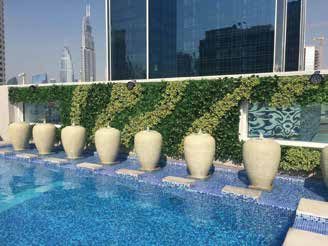
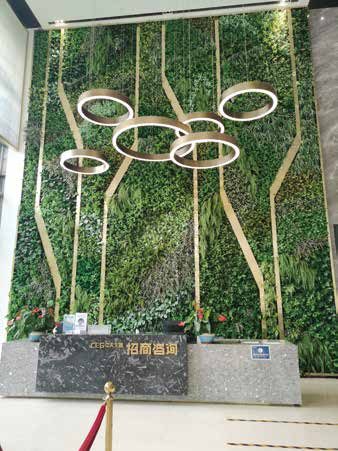
Real installations in this kind of setting — on-site photographs, no mock-ups.
Comparing hedges for a live project?
Send the hedge length and height, where it sits (indoor, outdoor, coastal), and whether a fire standard applies. We will come back with the panel formats that fit, the cleaning expectations, and pricing — normally within 24 hours on business days.
Sister brand · GardenStone
Pair it with landscaping stone (GardenStone)
From the same supplier group — GardenStone supplies decorative pebbles, gravel and landscape stone that complete the same hotels, resorts, malls and Japanese gardens. One source for the whole landscape.
Explore GardenStone →